Friday, March 14, 2014

Astrophotography: On the Importance of Post Processing

I'ld love to create a how-to guide on astrophotography, although a full length article detailing my workflow would probably bore any reader to death. In this post, I will be going slightly more in-depth on the practicalities of Astrophotography, particularly on the topic of post processing. Here, I will explain how I got the image of the Orion Nebula as I uploaded in this post

Before I go any further, I'ld like to mention quickly the three main components of Astrophotography. These are data acquisition, stacking, and post processing. Data acquisition refers to the actual act of going out to take photos. The actual setup of astrophotography equipment deserves an entire article in its own right, and there is already quite a large amount of information on this, because it is the first, and perhaps most important step. To cut the long story short, data acquisition for deep sky astrophotography involves taking a series of extended exposures, each of which are known as sub-exposures (or subs for short), and subsequently combining them in a process known as stacking.

Stacking is one of the key techniques in astrophotography, where catching faint light is of utmost priority. An extended single exposure can only do so much before mount tracking errors, sudden shakes, or unfortunate incidents like planes crossing the field of view destroy the image. To prevent this, multiple images are combined to create a master exposure, a high data RAW (e.g. TIFF) file where data can be extracted from through post-processing software, such as Photoshop. In order to stack images, it is necessary to have stacking software. A free example (and one of the best, in my opinion), is deep sky stacker. Aside from just the sub exposures, other types of exposures such as dark frames and bias frames are also applied, which I will elaborate further in another future article.

Before I bore you any further with massive walls of text, here is a picture of what one sub exposure looks like. This particular exposure is 20 seconds long, and shot at ISO 800.
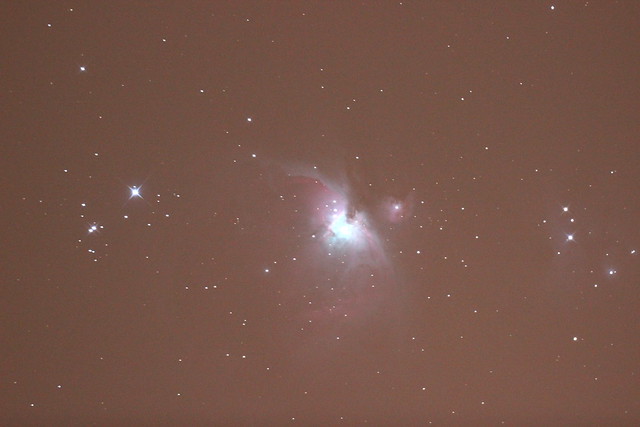

Here, you can see that the sky background glows a bright orange. This is the effect of heavy light pollution from the city, with mercury-sodium lamps blasting orange light into the atmosphere and drowning precious starlight. The inner nebulosity is still clearly visible, with a hint of the outer arms, as well as nebulosity in the running man nebula. However, with a nebula as bright as M42, astrophotography from cities is still possible. 

The next image below shows a stack of a few hundred of such sub-exposures. The total integrated exposure time, adding all the data from the subs, is about 1 hour. 
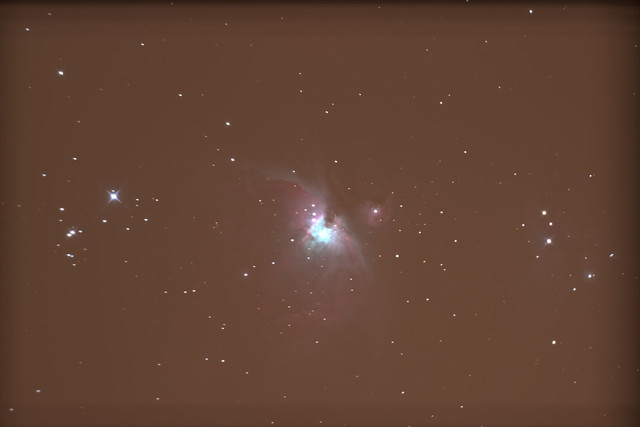

The first thing you may notice upon seeing this picture is that it appears to lack the detail of the final image. In fact, it appears less detailed than the original sub exposure! Surely stacking hundreds of subs would create something that looks better than one!

Well, it is important to think of these preliminary image files not as simply pictures on a film, but as a data file. The second image is a massive 32 bit TIFF file (although it is a JPEG here, since I can't upload TIFF files to blogger), as compared to the 8 bit JPEG above. TIFF files are normally hundreds of megabytes, while JPEG files of the same resolution are normally less than 10 MB. Aside from this, the image noise, or graininess, is much more pronounced in a single sub than the stacked image. Image noise drowns out actual data, so the low noise TIFF actually contains much more data (signal-to-noise ratio) than the original sub.

Now that we have the stacked image, it should be clear why post-processing is such an integral part of astrophotography. Firstly, it removes the unwanted orange colouration of the background sky, which plagues all images taken from city centres, all the way to even suburban sites. Secondly, it helps to pull out faint detail from the high data RAW file to show the fullest extent of nebulosity captured by the original data files. 

In order to do so, I applied a series of curves to stretch the histogram data. Data stretching increases the visibility of faint areas, as well as to increase the overall contrast. Typically, several iterations are done, with layer masks introduced in certain cases to improve dynamic range, or to even out uneven field illumination. In the case of dynamic range, the dynamic range of the orion nebula is actually quite large, due to the core being much brighter than there outer areas. As such, layer masks are applied to prevent overexposure (data clipping) of core detail. 

In between stretching, I also alter the colour balance to give a more neutral colour to the sky background. Normally, the cyan and blue channels are increased to neutralise the effect of the orange-red skyglow. Further changing the degree of colour balancing on the shadows, midtones and highlights separately gives further control, allowing the colour balance of the nebula itself to be maintained. 

Aside from stretching and rebalancing the colours, I also manually edited some of the stars to remove star trails arising from the optical issues of a parabolic mirror (and bad collimation). Preferably, such issues should be settled during the data acquisition stage, although in this case I only solved the problem afterwards. 

Once again, here is the final image. 
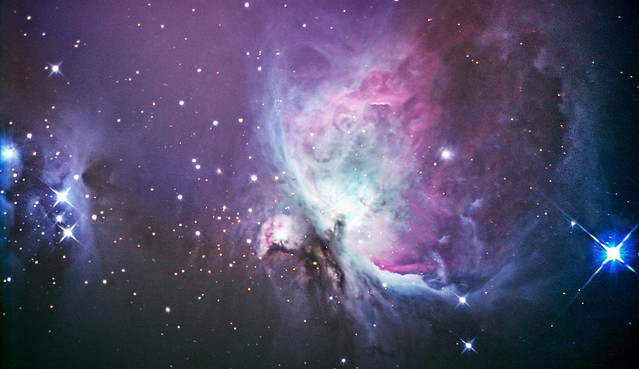

Compared to the original sub-exposure and stacked RAW file, this image shows quite a lot of detail that is only extracted through post processing. Indeed, this is why post processing is an integral part of deep sky Astrophotography. Within the photography community, post processing is something that is highly controversial, with opponents chanting the mantra that everything should be done right in camera. Such matters are mostly personal preference, although the fact that astrophotography necessitates this makes it a form of photography not for the purist. 

A question that many ask, therefore, is whether these images are 'real', or truly representative of what is out there. The answer is actually both yes and no. Yes in the sense that what you see in the image really exists in space, but no in the sense that no human eye, through any optical instrument, will ever see such a view. To me, the fine balance between showing what's real, as well as making the image beautiful, is struck here. Perhaps, this is what makes astrophotos taken by yourself special to you, in that the final image is representative of YOUR opinion. 

Monday, March 3, 2014

Astrophotography: The Omega Centauri Globular Cluster

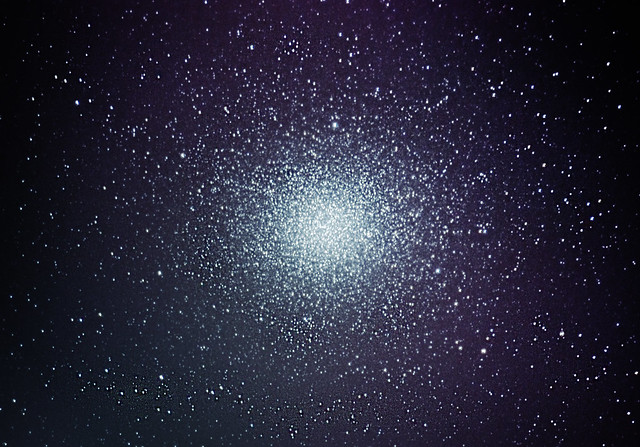
The Omega Centauri Globular Cluster in the southern constellation of Centaurus, featuring a beautiful globe of stars concentrated towards the centre. 

Photographic Information:

Imaging location: Kranji, Singapore (Light pollution: Red zone/Outer City)
Date of data acquisition: 1 March 2014
Exposure Details: ~45min, 800mm FL at f/4
Camera: Canon EOS 600D Unmodified
Stacked with DSS, adjustment of curves and colors in Adobe Photoshop CS6. 


Description:

The Omega Centauri Globular cluster is the largest globular cluster in the Milky Way Galaxy, and is located 15,800 light years away in the constellation of Centaurus. With probably over a million stars, and a combined mass of over 4 million suns, Omega Centauri is the brightest globular cluster that can be seen from Earth, shining at a visual magnitude of +3.9, an easy target with the naked eye from suburban skies. 

Because of the unique features of Omega Centauri that distinguishes it from other globular clusters, it is thought that it originated as a separate dwarf galaxy that got consumed by the Milky Way. 

Random rambles: On the Challenges and Rewards of Astrophotography

Astrophotography, particularly deep sky astrophotography, is indeed one of the most demanding forms of photography. Unlike most forms of conventional photography, images are often planned long beforehand, and exposures typically last upwards of an hour. Post processing is also a must, and because of this, astrophotography is not something for a purist. Heavy adjustments to colour, data stretching and manipulation are all essential in order to bring out the faint starlight and details of astronomical objects from the glow of the sky.

Where conventional photography typically yields multiple photographs from a single session, astrophotography is hardly as productive. A single night may only produce a single image, or if one is lucky, two or more. Sky conditions are also constantly on the change, and favourable weather may not always be present. With the glow of city lights, astrophotography can be incredibly challenging when the background colour of the sky isn't even black.

Furthermore, it is essential for all equipment for astrophotography to operate seamlessly. The failure of any one system will result in it being incredibly difficult to image. The mount must be capable of tracking stars to pinpoint accuracy, alongside the autoguider working with computerised systems in keeping the mount locked to the movement of the sky. The optical tube must be at thermal equilibrium with the surroundings, or condensation will affect optical transparency. The camera must be working even in the cold of the night. Last but not least, the power source must operate properly, alongside all electrical connections, in order to keep all the electronic systems working.

Despite all of these challenges, astrophotography can be very rewarding. There is a reason that I enjoy engaging in it. Although there can be many failures and setbacks, with so much beyond our control, the difficulty in acquiring these images seems to what makes the resulting images so much more precious.

In addition, acquiring the shots in an imaging session is only half of what makes astrophotos tick - the other half comes from post processing. Even if all the settings and conditions from an imaging session are the same, the images that result at the end, after stacking and processing, are often different. The choices to be made, from how the colour is balanced, to how the data is extracted and stretched from the RAW stacked image, is actually up to the individual. In the end, it actually becomes a very personal thing, even if the original images acquired look more or less the same.

When one looks at photos of astronomical objects, it is not just about the aesthetic beauty that is amazing about it. Perhaps even more so, is the understanding of what we are looking at. The staggering scale of the cosmos, and the grand physical processes that create these objects in space are profoundly humbling when we look at it from a cosmic perspective. There is so much more beyond the Earth, and so more that we have yet to see. Our knowledge as a species, far as we have come, is still far from being capable of comprehending the entire Universe. The satisfaction from being able to capture the faint light from distant celestial objects is also difficult to put into words, and it is this satisfaction that drives me to pursue this passion.

Saturday, March 1, 2014

Astrophotography: The Keyhole Nebula

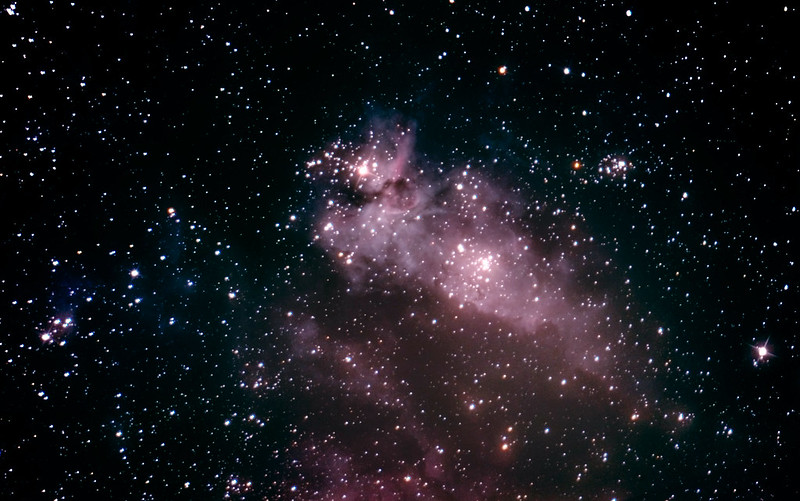
The Keyhole Nebula (NGC 3324), a part of the much larger Grand Nebula in the southern constellation of Carina. 

Photographic Information:

Imaging location: Kranji, Singapore (Light pollution: Red zone/City)
Date of data acquisition: 1 March 2014
Exposure Details: ~60min, 800mm FL at f/4
Camera: Canon EOS 600D Unmodified
Stacked with DSS, adjustment of curves and colors in Adobe Photoshop CS6. 


Description:

The Carina Nebula, affectionally known to many as the Grand Nebula, is a large diffuse nebula in the constellation of Carina that surrounds the hypergiant star Eta Carina. Although it is brighter and larger than the Great Nebula in Orion, it is less well known because of its position in the southern sky.

Here, only a section of the Carina Nebula is framed. The object visible here is known as the keyhole nebula, which is both an emission and absorption nebula. The strong red colouration comes from the presence of hydrogen clouds which are ionised by the highly energetic O-class stars in the region.

Because I imaged this object from the Equator, its maximum elevation over the highly light polluted horizon is only about 30 degrees. As such, much of the fainter details are drowned from city light. Still, because of the brightness of this nebula, it is still possible to see quite a fair bit of detail on the brighter elements.

Wednesday, February 26, 2014

Astrophotography: The Sword of Orion and The Alnitak Region in Orion

A) The Sword of Orion, featuring the Running Man nebula (NGC 1973/5/7) to the top and the Great Nebula in Orion (M42/NGC 1976) to the bottom. 

Photographic Information:

Imaging location: Thomson, Singapore (Light pollution: White zone/Inner City)
Date of data acquisition: 31 January 2014
Exposure Details: ~45min, 800mm FL at f/4
Camera: Canon EOS 600D Unmodified
Stacked with DSS, adjustment of curves and colors in Adobe Photoshop CS6. 


Description:

The term 'nebula' is a very generic term that can mean quite a number of things. The word 'nebula' actually originated from the latin word for 'cloud', and can therefore be used on almost any astronomical object that appears fuzzy looking. In this case, however, it means something much more specific, and that is a stellar nursery; a place where stars are born. 

In this image, vast swaths of blue and red cover the image, and these represent giant clouds of gas and dust. Quite literally, what you are looking at is stardust - stardust which form the ingredients that future stars are made of. 

The blue coloration in the image originates from starlight coming from the bright young stars reflecting off the nebula. Most of the stars here are O-class stars, which are the largest, brightest and hottest stars in the Universe. The intense light emitted by these stars reflect off the diffuse hydrogen clouds, giving a soft bluish glow. 

On the other hand, the red coloration represents something more interesting. O-class stars, with surface temperatures ranging tens of thousands of degrees, emit copious amounts of high energy ionizing radiation. Large amounts of ultraviolet light strip away the electrons from the interstellar hydrogen, leaving behind its positive nucleus. As the electrons recombine with the nuclei to re-form atomic hydrogen, it passes through a series of energetic transitions. Because of the distinct energy gaps between electron shells, the wavelength of light emitted during these transitions is the same. One such transition, in which the electron drops from the third energy level to the second closest to the nuclei, produces a very precise wavelength of light. This emission line is known as hydrogen alpha (HA), and produces red light at exactly 656.281 nanometers. 

The importance of hydrogen alpha emissions is that it gives us an idea of the composition of nebulae. When large amounts of HA is emitted, it implies that large amounts of atomic hydrogen exist in the nebula. Atomic hydrogen is important because it forms the main ingredient that triggers star formation. 

Even despite imaging from close to the heart of a highly light-polluted city, details of the outer nebulosity are visible. Exceptional weather conditions, as well as taking as many sub-exposures as possible, contribute to pulling out faint detail in astrophotography. 

B) The Alnitak Region in Orion, featuring the Flame Nebula, Horsehead Nebula, and of course, the star Alnitak. 

Photographic Information:

Imaging location: Thomson, Singapore (Light pollution: White zone/Inner City)
Date of data acquisition: 31 January 2014
Exposure Details: ~30min, 800mm FL at f/4
Camera: Canon EOS 350D Modified (IR Filter removed)
Stacked with DSS, adjustment of curves and colors in Adobe Photoshop CS6. 


Description:

The Flame nebula and Horsehead nebula, like the Orion nebula above, is a diffuse nebula where stars are born. Unlike the Orion nebula, however, the Flame and Horsehead undergo very little reflection nebulosity. The main emission line coming from these two nebulae are from Hydrogen Alpha, which gives it the characteristic red hue. Due to the colour processing however, the hue is shifted towards magenta rather than its true colour. 

The bright star in this picture is Alnitak, one of the brightest stars in the sky, and the westernmost star of Orion's belt. Like the young stars in the Great Orion Nebula, Alnitak is a massive O-class star, producing violent amounts of ionising radiation. The relentless burst of energy from Alnitak is what drives the incandescent nebulosity of the Flame nebula. 

The horsehead nebula is actually an absorption (dark) nebula, silhouetted against the soft glow of an emission nebula. Without this 'curtain' that lights up from behind, we wouldn't be able to see the horsehead in visible light. Even then, the horsehead is typically regarded as a challenging astronomical object to see and image because of its dimness. 

In order to bring out the horsehead, especially from such a highly light polluted region, a modified DSLR camera has to be used. Because the hydrogen alpha line in the visible spectrum lies so close to the infrared, unmodified DSLRs are very insensitive to such wavelengths, as are the human eyes. As such, the removal of the in-built UV/IR filters and its subsequent replacement with a clear glass plate will bring up the sensitivity of the sensor to these wavelengths, allowing the horsehead to appear. 

Our place in the Cosmos, and Reflections on Epistemology from a Scientific Perspective

“The human race is just a chemical scum on a moderate-sized planet, orbiting around a very average star in the outer suburb of one among a hundred billion galaxies”

The above quote, as famously put by Professor Stephen Hawking, aptly places our place in the universe in perspective. The human race is but one of billions of species that have walked on the Earth, and the Earth is, on planetary scales, a very average planet, orbiting a very average star. The sun is just one out of the estimated three hundred billion stars in the Milky Way galaxy, which is in turn a pretty mundane collection of stars in the Universe where at least a hundred billion others exist. If there is anything to be said about our place in the universe, we can be almost certain that we are nowhere privileged. We are but a grain of sand in an endless ocean.

As if being insignificant weren't enough, we could even see ourselves as a 'chemical scum’. The major elements that make up the human body, aside from primordial hydrogen, were cooked up in the hearts of stars that have lived and died. We are made up of nuclear ash, a chemical waste from the guts of dead stars. The elements that make up you and I are no more special than a chunk of rotting log.

For centuries, we have pondered about our place in the Universe – it seems almost as though mankind has had an obsession with wanting to be in a special position, one in which all of existence revolves around.  With the geocentric model of the universe being mostly unchallenged for over a millennium, the advent of Copernican heliocentrism seemed to have kicked start a wave of new discoveries that relegated our position into the distant periphery.

Perhaps, then, we shouldn’t quite determine how special we are from our literal place in the cosmos, or the reductionist perspective of the individual elements that make up our bodies. After all it isn’t a matter of substance that makes us who we are. Human life, as many would agree, is worth more than its weight in gold. Life differs from non-life not in terms of substance, but in terms of information. Digital information, arranged in bits of the nucleotide sequence that form the library of blueprints that make up all organisms.

It is almost unarguable that the trait that distinguishes us humans from any other species lies in a single organ: the brain. Not only can information be transferred in the form of genetic language from ancestor to descendant, it can now be stored, understood, and processed in a multiplicity of ways, limited only by the complex circuitry of neuronal complexes. Although the brain isn’t unique to humans, the ability of human brains to comprehend the natural world to such great depth beyond any other species is what has enabled us to dominate the globe. 

Furthermore, the ability of the human mind to comprehend the workings of the universe stretches above and beyond the purposes of hunting or maintaining survivability. It is more than just a curiosity of runaway evolution. It represents, above all, the universe understanding itself. We are in the universe, and a very small part indeed, but in some sense, the universe is also in us.

One video that I came across some time ago that inspired me to make this post is a speech made by physicist Dr. David Deutsch. His speech at the TED talks, titled ‘The Chemical Scum that Dream of Distant Supernovae”, describes what knowledge actually is. The ideas here represent what insights science brings to epistemology, or the philosophy of knowledge, and how this perspective of what knowledge actually is relates to our unique position, metaphorically speaking, in the universe.

The main part that I found incredibly thought provoking was his description of what knowledge is, with reference to Quasars billions of light years away. It is also this amazing speech that I would end this post with. For convenience, as well as for the benefit of those who are unable to view the video, I have typed out a slightly paraphrased transcript of what he said in the video below.


“Look out even further than [the Earth], with a telescope, and you’ll see things that look like stars. They are called ‘Quasars’. Quasars originally meant ‘Quasi Stellar Object’, which means things that look a little bit like stars.  But they’re not stars, and we know what they are. Billions of years ago, and billions of light years away, the material at the center of a galaxy collapsed towards a supermassive black hole. And then, intense magnetic fields directed some of the energy of that gravitational collapse (and some of the matter) back out in the form of tremendous jets, which illuminated lobes the brilliance of a trillion suns.

The physics of the human brain could hardly be more unlike the physics of such a jet. We couldn’t survive for an instant in it; the language breaks down when trying to describe what it would be like in one of those jets. It would be a little like experiencing a supernova explosion, but at point blank range, and for millions of years at a time.  And yet, that jet happened at precisely such a way, that billions of years later on the other side of the universe, some bit of ‘chemical scum’ could accurately describe, model, predict, and above all, explain what was happening there in reality. The one physical system (i.e. the brain) contains an accurate model of the other (i.e. the quasar). It’s not just a superficial model of it (although it contains that as well), but also an explanatory model embodying the same mathematical relationship and same causal structure. Now that is knowledge.

And if that weren’t amazing enough, the faithfulness with which the one structure resembles the other is increasing with time, and that is the growth of knowledge. The laws of physics have this special property: physical objects as unlike as they could possibly be can nevertheless embody the same mathematical and causal structure, and to do it more and more so over time.


We are a chemical scum that is different. This chemical scum has universality. Its structure contains, with ever-increasing precision, the structure of everything. This place, and not other places in the universe, is a hub, which contains within itself the structural and causal essence of the whole of the rest of physical reality. So far from being insignificant, the fact that the laws of physics allow this, or even mandate that this can happen, is one of the most important things about the physical world. “

An Introduction to this Blog

Good Day to all my Readers,

I have created many blogs in the past which I have since abandoned, and I'm honestly not sure if this will be any different. I have dedicated it to writing about astronomy and science, and perhaps an extension of these into philosophy. 

I guess this will be where I keep my random musings about astronomy and science in general, as well as my personal path in amateur astronomy and astrophotography. Having been living a city life my entire life, I have hardly got to experience the serenity of nature, nor the beauty of the milky way from the suburbs. 

I have always had a passion for astronomy every since my childhood days, and I have been in the hobby of amateur practical astronomy for about 6 years. I'm also interested in photographing the night sky, and capturing the wonders of the universe on 'film'. As such, I will also be posting my pictures that I have taken, which will probably mostly be from Singapore. Hopefully, this will inspire others living in the city, who may not find it easy to travel outwards into rural areas, to engage in this delightful hobby.

Thanks for dropping by and enjoy your stay!

~ Ivan